Harvesting the Tree

The initial oddity of Plate VI would seem be its title. Six of the seven parables are numbered, but after “The First Parable” is “The Other Parable”. Since the upper portion of Plate V is primarily themed regarding meditation, it would seem Plate VI here is to continue along this line. Those of us with any degree of experience with the meditation process would have to agree that the beginning effort is primarily concerned with calming, quieting and ridding the mind of its perpetual internal dialogues. This takes consistent, concerted practice over a period. If having somewhat accomplished that level through considerable efforts, we may be drawn deeper. Hence, the other challenges depicted here.
Central to this illustration is the Tree of Life. The Golden Crown at the trunk’s base is Kether. This makes the branch foliage at the top Yesod, the Foundation. This reversed representation of the Tree confirms the assignment of Yesod being the Foundation of the Conscious Mind in its physical vehicle of sensations and of all that which is without. Yesod is NOT the Foundation of the other eight Sephiroth above it when the Tree is in its normally familiar presentation. Malkuth, the tenth Sphere, represents the Conscious Life in this world of 3-dimensional space, time and material forms.
Yesod is the next inner level, the automatic consciousness, or Subconscious. It, then, is truly ‘The Other’ most immediate level of conscious awareness. The psychological sciences tell us that this level within us is the store-house of all we have ever thought, felt or experienced throughout this life. And that its accrued data perpetually influences our current thoughts and actions for better or worse. The esoteric knowledge of the sages throughout history have taught their aspirants that this ‘store-house’ goes far deeper than the psychological community is able to access.
In Qabalah the Subconscious level is that which is designated by the term Yetzirah, the World of Formation, which forms the basis of our physical lives in Assiah. It borders on the Super-conscious. However, to access that Super-conscious level we must first clear, as best possible, that level of consciousness, that ‘sub’ level, of all the accumulated ‘dross’ not only from our present so-called ‘personal’ life, but also the influences from the race consciousness of this incarnation, and from all our previous incarnations included. Fortunately we receive help with those profound depths if we are persistent with our aspirations.
The scripted portion of this Parable begins with the “Water of the Air”, which is Solar Prana, the “Life of everything”; also called Dew of Heaven. The author continues with the virtues of this Water, then moves on to the Tree.
The various inconsequential birds representing Yetziratic thoughts are disbursed and fleeing, calming the conscious mind somewhat. The only bird remaining is the White-headed Raven. The Raven (aka, The Black Crow) has been called the ‘Door of the Art’. It refers to Binah as the aperture of Radiant Darkness from whence all proceeds into manifestation. Binah is also the Great Deep beyond the ‘personal’ Subconscious depths represented by Yesod as the top of the Tree in the illustration. From the Latin Cabala Simplex the ‘White Raven Head’ is corvus albus caput. These letters sum up to 191. This equates with sanctum sanctorum, ‘the Holy of Holies’, the Cubical room within Solomon’s Temple. Within us, however, it is the full maturation of the pineal body and the aperture into eternal conscious immortality. The ‘Road Within’ towards that depth is personified by this White-headed Raven atop the Tree. The conclusion need not be elaborated here.
The seven rungs* of the ladder represent the seven force-centers, Chakras, inner Planets or ‘Metals’ of the Alchemists. These must be activated, balanced and coordinated with each other to turn the Raven’s Head White. Dressed in black (Tamas Guna) the male (conscious mind) atop the two uppermost rungs (the Mercury and Moon Chakras) is attempting to clear some of the Tamas Guna dross in Yesod.
Protracted study and meditations into the Tree of Life produce and gather “three kinds of Fruit” (from the written portion of the Parable):
- Pearls is margaritae and sums to 85 in LCS. So does veritas ‘truth’; and Dominus ‘Lord’, used in place of the Tetragrammaton in scripture. ‘Finest pearls’ is optimae margaritae, which sums to 156, along with in centro solis, ‘in the center of the Sun’, which speaks to the purest Gold.
- Perfumed Earth or ‘scented Earth’ is terra foliata, a fragrance rising from within, accompanying a profound meditation. This sums to 114, that of מדע, maduo, ‘science, or knowledge’ derived from the Hidden Science of Qabalah.
- The very purest Gold is an obvious reference to Tiphareth. The Gematria ventures all over the place with these variations: ‘Pure Gold’, aurum purum at 145; ‘Most pure Gold’, aurum purissimum, at 208; ‘Purest Gold’, ex auro purissima, at 199; and ‘very purest Gold’, ipsum ex auro purissimo, at 269. Developing each of these would be distracting here. The numbers given allows the reader personal research, which will render far more insight over merely reading these notes.
Lunatica, moonstruck, sums to 73, that of חכמה, Chokmah (Wisdom) and Berissa, morning, sums to 67, that of בינה, Binah (Understanding). The “root is a Metallic Earth” is Kether.
Those branches, clear of petty thought or dross, become worthy enough to be presented to the deeper levels represented by the Sages and Masters whose consciousness dwells between those levels of Yesod and The Crown. This is from whence comes our help; the Christ level of Consciousness, working toward us, outward/downward, as we aspire upward/inward toward Him.
The very deep levels of Subconsciousness, represented by the four women in the Bath, are slowly being purified by our meditations with the help of the Christ Consciousness in the Four Worlds. They are being attended by the women representing Rajas Guna (Red/Sulfur) together with Sattva Guna (Yellow/Mercury) in the Metal, Silver; making “Mercury of Silver”, alchemically speaking. As long as these two modes within Subconsciousness are bound together progression on The Path is assured. The inconsequential aspects of the Self and Subconscious mental modes (the men and women gathered around, gawking at the central scene), have no direct bearing on the principal operation.
*Editors Note
On closer inspection of the ladder in this image, it may be seen that there are not seven rungs, but nine. The eighth rung is hidden by the figure in black and the ninth is visible just above his hip as he leans over.
This feature alludes to the patriarch Jacob who, laying his head upon a stone, dreamed of the angels of God ascending and descending on a ladder extending up to heaven. Jacob’s hip is later put out of joint by an angel he has spent the night wrestling, as he cries, “I will not let you go except you bless me!” The angel blesses him and changes his name to Israel, and he names the place Peniel.
In his first book, Fulcanelli explains a bas-relief on the Great Porch of Notre-Dame, Paris, showing a ladder with nine rungs reaching to the heavens, as follows:
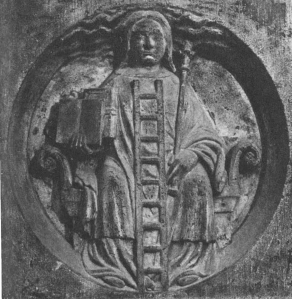
“The pier, which divides the entrance bay, shows a series of allegorical representations of the medieval sciences. In the place of honour, facing the parvis, alchemy is represented by a woman, with her head touching the clouds. Seated on a throne, she holds in her left hand a sceptre, the sign of royal power, while her right hand supports two books, one closed (esotericism), the other open (exotericism). Supported between her knees and leaning against her chest, is the ladder with nine rungs — scala philosophorum – hieroglyph of the patience which the faithful must possess in the course of the nine successive operations of the hermetic labour. ‘Patience is the Philosophers’ ladder,’ Valois tells us, ‘and humility is the door to their garden; for whosoever will persevere without pride and without envy, on him God will show mercy.'” Le Mystère des Cathédrales, page 70.
Fulcanelli then describes another bas-relief in the doorway to Notre-Dame, a mysterious fountain flowing out of an oak. He says, “The artist has come a long way; he has taken false turnings and wandered on doubtful paths; but finally his joy bursts forth! The stream of living water flows at his feet; it gushes out bubbling from the old hollow oak.” ibid, page 47.
Finally, he gives some commentary on Plate IV of Splendor Solis:
“Let me also mention a figure in Trismosin’s book … It shows an oak, from whose foot—encircled by a gold crown—issues a secret stream, which flows away into the distance. In the foliage of the tree, white birds are disporting themselves, with the exception of a crow, which appears to be asleep and which a poorly-dressed man on a ladder is about to catch. In the foreground of this rustic scene there are two sophists, elegantly dressed in sumptuous materials, who are discussing and arguing a scientific point, without noticing the oak tree behind and without seeing the Fountain flowing at their feet.” ibid, page 76.
In Latin, scala philosophorum sums to 197 as two other words in two other languanges:
• In Hebrew, the name Emmanuel, עמנואל, meaning ‘El (god) with us’.
• In Greek, agorazei, αγοραζει, meaning ‘purchased’, used by Jesus in parable: “Again, the kingdom of heaven is like a treasure hid in a field; which when a man found, he hid, and for joy went and sold all that he had, and purchased that field.” Matthew 13:44
Jacob’s ladder is סלם יעקב, sulam Yakov, summing to 312. But also עין יעקב, ayin Yakov, meaning ‘the fountain (lit. ‘eye’) of Jacob’ from Deuteronomy 33:28: “Israel then shall dwell in safety alone: the fountain of Jacob shall be upon a land of corn and wine; also his heavens shall drop down dew.”
Kabbalists give another clue to the identity of Israel in the Jewish homophone “Yashar El”, which means ‘straight to God’.
Fulvo nimis margaritas
 James Investigates